
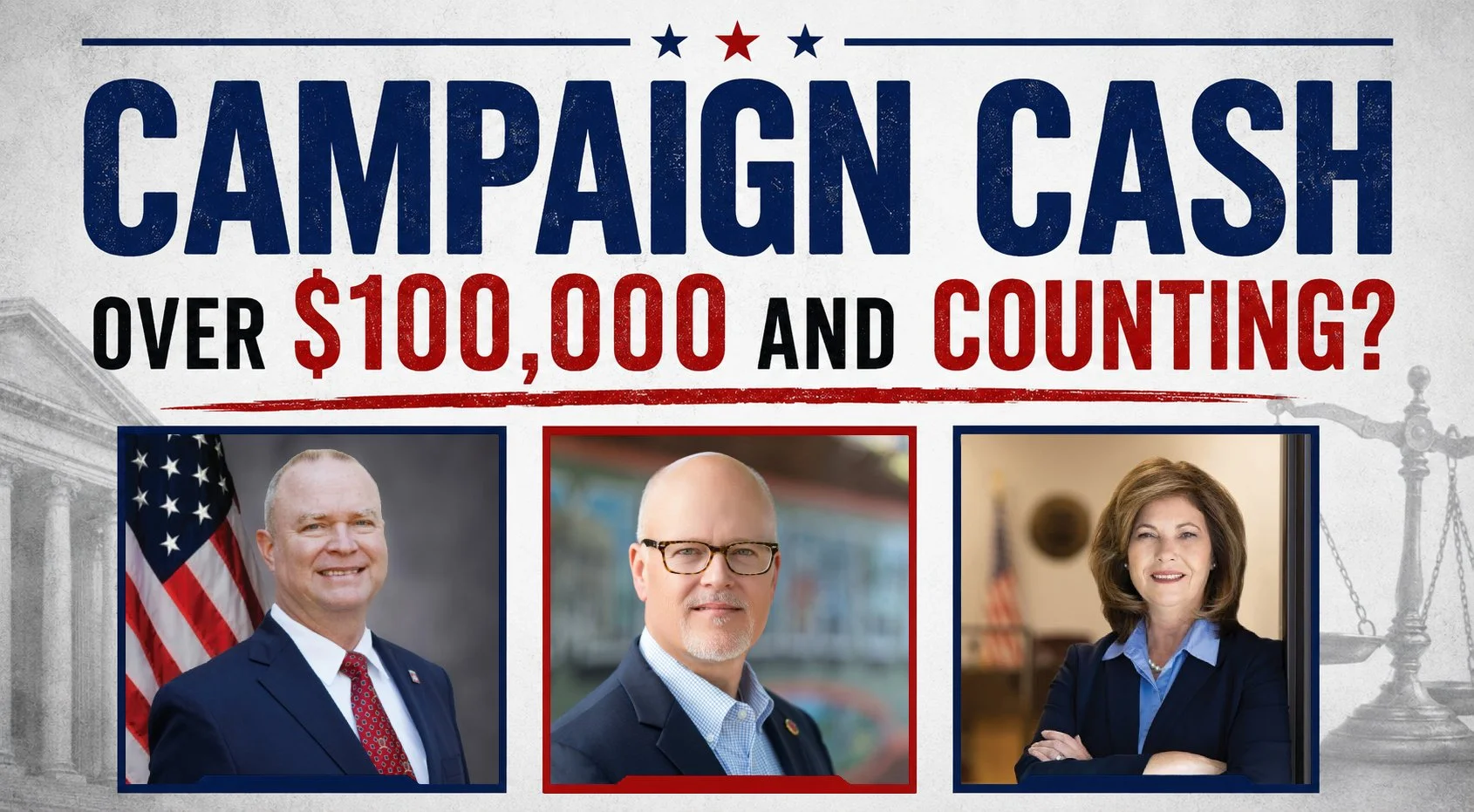
The District Attorney candidates are, from left, Matt Colvard, Randal Gilliam and Lisa Zavogiannis.
More than $100,000 has already flowed through the three campaigns for the 31st Judicial District Attorney, with the candidates pouring money into signs, billboards, advertisements, direct mail and outside campaign services in the race’s closing months.
And that total is currently still incomplete.
Campaign finance reports filed by Lisa Zavogiannis and Randal Gilliam show both continued spending through July 27, but no pre-general disclosure from Matthew Colvard was available on the Tennessee Online Campaign Finance website as of Sunday, Aug. 2 at 11:30 a.m.
All three filed second quarter disclosures earlier this month, as well as first quarter disclosures in April and early year end supplemental 2025 disclosures in January.
According to the state’s website, the pre-general report was due Thursday, July 30 and was required to cover campaign activity from July 1 through July 27 for candidates participating in the Aug. 6 general election. Tennessee defines a report as filed when it is received by the Registry or, when sent by certified or registered mail, by its postmark date.
Zavogiannis and Gilliam each submitted pre-general reports July 28.
Without Colvard’s report, it is not yet possible to know how much he raised or spent during the first 27 days of July, how much money remained in his campaign account entering the final stretch or whether he made additional personal contributions to support his campaign.
It is unclear if Colvard’s report was submitted late or if the state’s website has not updated with his most recent filings.
If the report was submitted late, according to the state’s website, “The Registry may impose class one (1) civil penalties of twenty-five dollars ($25) a day up to a maximum of seven hundred fifty dollars ($750) for the late filing of any campaign financial disclosure report required to be filed either with the Registry or the county election commission. The law sets specific procedures that must be followed whenever the Registry or a county election commission discovers that a required report has not been filed. T.C.A. § 2-10-110(a)(1).”

According to the reporting, which is public record and available on TN.gov, Zavogiannis leads the field with $75,260.74 in reported expenditures. Gilliam has spent $41,576.67, while Colvard has spent $35,939.29 (which does not include his potential July spending).
The candidates have also taken three different approaches to paying for their campaigns.
Zavogiannis has relied most heavily on personal loans, lending her campaign $70,000 while raising $10,550 in monetary contributions from supporters. Her pre-general report showed $70,000 in outstanding loans and $5,289.26 remaining in the campaign account.
Gilliam has reported $31,500 in personal loans and $19,357.66 in monetary contributions, although that contribution total includes a $500 contribution he made to his own campaign. Excluding that contribution, Gilliam raised $18,857.66 from other donors. He reported $9,280.99 remaining entering the final campaign period.
Colvard has not reported any candidate loans. Instead, he contributed directly to his campaign, giving $25,000 through June 30.
Colvard raised another $17,105 from other donors, including unitemized contributions, through the end of June. His second-quarter report showed $6,165.71 remaining, but that figure is now more than a month old and does not reflect any July fundraising or spending.
The filings show that visibility has come at a significant cost.
The three campaigns reported spending at least $27,885 specifically on billboards or outdoor advertising.
Zavogiannis spent $14,400 with Billboard Source Inc. during the first quarter and another $2,000 with Rowland Digital Media during the second quarter, while Gilliam reported a $4,150 payment to Lamar for advertising.
Colvard reported three Lamar payments totaling $4,650 and another $2,685 payment to Roland Digital Media for advertising, giving him at least $7,335 in spending tied to those outdoor and digital vendors.
All three campaigns also purchased advertising from Main Street Media: Zavogiannis spent $5,095 with the company, including $1,850 during the second quarter and $3,245 during the pre-general period. Gilliam spent $2,500 through two $1,250 payments. Colvard reported one $750 expenditure through June 30.
Gilliam also spent $2,748.02 to Warren First 931, including three payments totaling $1,600 during the second quarter and another $1,148.02 in July. Zavogiannis also spent $500 with Warren First for advertisin.
Zavogiannis also spent $1,250 with the Southern Standard for advertising.
Mail became one of the most pronounced differences between the campaigns in the final stretch.
Zavogiannis spent $27,701.97 with E. Allan Brandon LLC. The Murfreesboro company has been identified in other campaign and organizational filings as a provider of political mail consulting, design, production and mailing services. Those two payments accounted for nearly 89 percent of Zavogiannis’ $31,255.97 in pre-general spending.
Gilliam’s pre-general report showed a less expensive mailing effort built around postage payments. His campaign paid a combined $3,844.10 to post offices in McMinnville, Doyle, Rock Island and Spencer on July 16.
Colvard had already paid $5,488.72 to Direct Edge Campaigns for printing June 30, one day before the pre-general reporting period began. His missing filing leaves unanswered whether he incurred additional production or postage costs for that material in July.
Consultants and professional-service providers have also played roles in each campaign, although the filings classify those services differently.
Colvard has reported the clearest consulting expense, paying Dual Advantage $6,000 through three payments - one in the first quarter for $3,000 and two $1,500 payments in his second quarter filing disclosure.
He also spent $5,488.72 with Direct Edge Campaigns for printing and $525 with RumbleUp for advertising and voter-contact services through June 30.
Zavogiannis paid $1,867 to Knoxville-based Spry Strategies for research and polling. Spry describes its services as including polling, voter identification, research, data modeling and political consulting. E. Allan Brandon LLC also has an established history of political mail consulting and production.
Thus far, Gilliam’s heaviest investment was in physical campaign materials, paying $21,586.40 to Custom Vinyl Signs and Shirts during the second quarter alone.
Altogether, the reports currently available show:
Zavogiannis spent $75,260.74, including $27,701.97 on mailouts and at least $16,400 on billboards and outdoor advertising. She personally loaned the campaign $70,000.
Gilliam spent $41,576.67, including $21,586.40 on shirts and signs while personally loaning the campaign $31,500.
Colvard spent $35,939.29 through June 30, including at least $7,335 with Lamar and Roland Digital Media and $6,000 on consulting through Dual Advantage. He contributed $25,000 to his campaign without classifying the money as loans.
The election will be settled Thursday, Aug. 6. Early voting concluded Saturday, Aug. 1 with Warren First reporting 5,073 voters made their decisions in the early voting period in Warren County. The 31st Judicial District also includes Van Buren County.
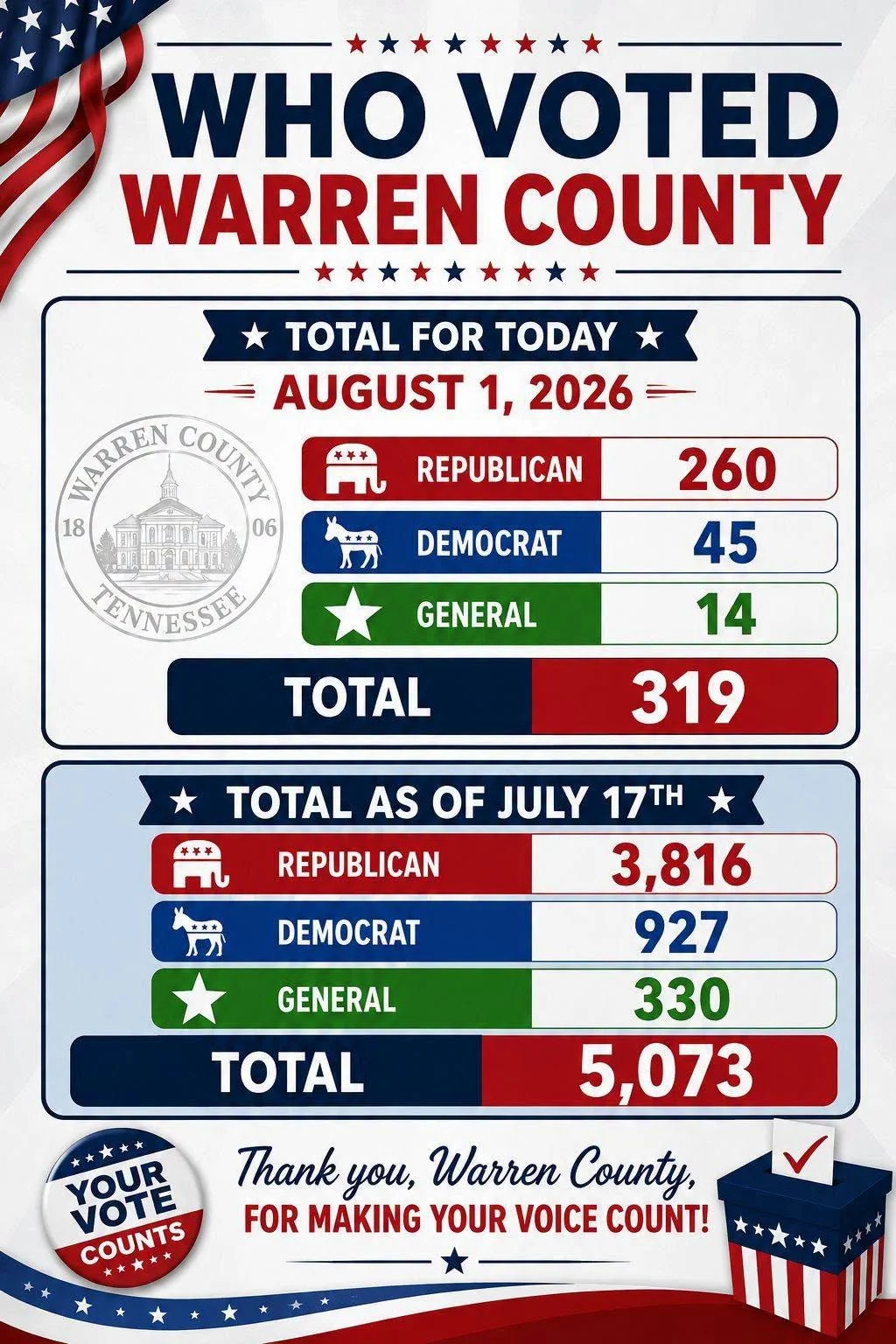
Numbers from Warren First 931
